Showing posts with label weather. Show all posts

Monday, August 14, 2017

Snow on Bluff Knoll


Just shy of 1100m high, Bluff Knoll is the highest peak in southern Western Australia and, as such, is the only place in Western Australia where snow is likely to fall every year. 

But, even on Bluff Knoll, snow is not exactly a common occurrence so when it does fall, it is something of an event and can result in traffic chaos.

Last year my son and I started doing some of the mountain hikes in our region and I also took an interest in reading weather charts in an attempt to predict snow. Last week those two pursuits came together and we  hiked to the top of Bluff Knoll to encounter a spectacular (by Western Australian standards) snow-covered landscape.

We woke at 2am, left home around 3am and arrived at a surprisingly empty Bluff Knoll car park almost an hour later. We began the 3km hike up the mountain around 4am, three hours before sunrise.

Luckily, the moon was almost full and the sky was clear so we had pretty good visibility, even when we turned our torches off. Once we exited the bush-land part of the walk and traversed the steady incline above the main treeline, we could see the mountain range for kilometres to the west although sunrise was still two hours away.

It was a slow, steady walk - made slower by me overheating twice.

Last Thursday morning was predicted to be one of the coldest mornings of the year and I was expecting wet, blustery weather - indeed there had been significant rainfall overnight - but morning on the mountain was clear and still. There was barely any breeze at all, so my five layers of clothing, plus ski gloves, very quickly turned out to be two layers of clothing and two gloves too many.

With that problem sorted, after two stops to shed layers and re-compose myself, we enjoyed a steady walk toward the summit.

By this stage, we had given up on any hope of seeing snow - it was far too pleasant. We were now just hoping to catch a nice sunrise from the top.

Near the 2km mark, we were overtaken by a reporter carrying a snowboard and after I wished him luck, he pointed to the snow at our feet. We hadn't noticed it in the dark.


From here on the snow increased almost exponentially every 20m or so, until it seemed like every surface, including every branch of every shrub, was caked in snow and ice. There wasn't nearly enough snow - or space - to truly accommodate a snow board, but the reporter was just providing a bit of humorous media fodder. 

The vista of snow slowed our walk still further as we stopped repeatedly to take photos in the pre-sunrise twilight. We eventually reached the top of the mountain just after sunrise and were greeted with the astonishing sight of the distant eastern ridge silhouetted against an orange sky with pink-orange sunlight streaming across the snow-covered foreground.

It was sublime. It was magical. It was, quite literally, a winter wonderland. And, if I am to work a painting angle into this story at all, let me say it provided a wonderful lesson in warm lights and cool shadows as it was difficult not to notice the orange-blue complements.

The best thing about this trip was that we were two of just a dozen or so people at the top. A month earlier, with snow predictions broadcast widely across social and mainstream media, hundreds of people converged to make the trek, resulting in access being restricted for most of the day by national park rangers.

But the best thing about this trip was the perfect weather. The throngs who battled the trek in July endured stormy, blizzard-like conditions with some snow flurries, but no snow on the ground.

But the best thing about this trip was that, although no snow fell for us, we saw possibly some of the best snow coverage this mountain ever enjoys.

But the best thing about this trip was that a quokka made an appearance at the top. Yep, I think that was definitely the icing on the cake - a quokka, on top of a mountain, in the snow. My son took a bunch of photos of it and, if you haven't already seen that story splashed all over the media, then I imagine a quick search will find it for you.


Please note, all images are copyright. Please do not re-publish without permission. Thanks.

Tuesday, August 9, 2016

Bluff Knoll Blizzard

Recently I've been learning a little about how to predict snow falls, especially in southern WA.

Snow is almost unheard of in this state but at 1095m above sea level, Bluff Knoll does enjoy a some light falls a few times a year.

I had been watching the weather charts all week and it was looking good for today and tomorrow. When I checked today's forecast this morning, it had possible snow drifts predicted for the Stirling Range this afternoon and evening.

My wife and I headed out to Bluff Knoll around 3pm. The sun was shining, the wind was light and there were clouds drifting across the top of Bluff Knoll. There was a definite chill in the air, but it was beautiful and serene.

I set my DSLR camera up on a tripod right next to my car so I could sit in relative warmth. I attached a timer cable and when I was done taking a few test shots, I looked up and there no more sunlight anywhere.

I set the timer to take one picture every five seconds and left it to shoot until the memory card was full.

Janet had "gone for a walk" and sent me a text message warning of some approaching dark clouds. The storm was soon with me and it hit with a vengeance. I was busy trying to tie the tripod down so it wouldn't blow over, as sleet whipped past me, piling up on the back window of the car, and soaking through my jacket and jeans.

Janet was "somewhere" on the walk trail, sheltering beside trees and basically getting soaked. She had a great time watching flurries of snow.

While I could only describe the weather I witnessed in the car park as "sleet" rather than "snow", there were people on top of the mountain and they most definitely enjoyed the real thing, even if it did arrive horizontally and and great speed. We met the brave souls before we packed up and they showed us photos of the snow on the ground. There was enough to make some snow balls.

The worst of the blizzard lasted around 15 minutes and quickly cleared. Soon after, the setting sun cast a warm glow over everything before ducking behind a cloud. Day soon turned to night, the camera's memory card was full and we packed up, dried ourselves off, chucked the heater on in the car and headed home.

Over 1 hour, 40 minutes the camera took just over 1500 photos. I used the images to create a one minute time-lapse video.


Thursday, November 14, 2013

Spring was here!

It took a while to arrive, but spring did show itself for a few days recently. But, with summer just two weeks away, the grey weather has returned.

I bought myself some new brushes recently. I've been using flat synthetic brushes for the last couple of years but now I'm returning to good old, tried and tested hog bristles. The synthetics started to get a little bit too frustrating as they loose shape fairly quickly, even with careful washing and storage. They also occasionally refused to let go of the paint when making a stroke and I found myself adding more and more turps or medium to try and get things to work properly. There were times where this seriously slowed things down and time is one commodity the plein air painter rarely has enough of.

I might write a bit more about that once I've tamed my new bristles.

The continuing grey weather has given the opportunity to spend a little time in the studio and this week I did something I've rarely done in the past - I painted over some plein air sketches that I felt needed a lift in order to become frame-worthy.

The first one is a painting I did a while ago. It was painted very late in the day and the light faded fast. I used a "pre-mix" approach where almost all the colours are mixed on the palette before any colour is applied to the painting surface.

I mixed a few main colours for the trees - shadows and highlights, warms and cools - two for the hills, a few for the ground and two for the clouds, plus some blues for the sky. This was a first for me and I can see some potential advantages in the method when the light is changing fast, but I'm not sure how often I'll use it. What I generally tend to do is use a mix-and-apply approach in combination with pre-mixes for some specific areas where I want to lock-in colours at a given time.
 
Plein air landscape oil painting - sheep - Andy Dolphin
  Porongurup Sheep. 
Plein air sketch. 35x25cm oil on board.
© Andy Dolphin

I liked the general structure of this one but the major forms were a little fractured and it lacked punch. I particularly wanted the sheep to catch a bit more of the evening sunlight. So I carefully scraped back the dry paint with a new palette knife, to get rid of the biggest ridges, and got to work. Here's the result...

Plein air landscape oil painting - sheep - Andy Dolphin
  Porongurup Sheep. 
35x25cm oil on board.
© Andy Dolphin

My second re-do was first just two weeks ago. It was a perfect afternoon and I hadn't looked at this location before. The distant air was thick with sunlit vapour and almost swallowed the Porongurup Range less than ten kilometres away.

This was the first time I used my new brushes and was very pleased with the process. Here's the painting as it stood when I packed up...

Plein air landscape oil painting - cattle - Andy Dolphin
  Takenup Cattle. 
Plein air sketch. 35x25cm oil on board.
© Andy Dolphin

...and a location shot, of course, for people who like that sort of thing...

Plein air landscape oil painting - Western Australia - Andy Dolphin

And here it is after I scraped back the ridges and painted over it in the studio.

Plein air landscape oil painting - cattle - Andy Dolphin
  Takenup Cattle. 
35x25cm oil on board.
© Andy Dolphin

I feel the end result does a far better job of capturing the glowing atmospheric light that attracted me in the first place. I also reduced some of the mid-ground clutter by deleting what appeared to be a second dam behind the one where the cows are standing.

In both cases, the major change I wanted to make was to add more warmth. I prefer bright, warm paintings but it can be easy to lose vibrancy when you're standing on the side of the road and painting quickly.

Both paintings were done - and re-done - using a three-colour palette.

Friday, September 20, 2013

Composition: plein air seascape in oil

When painting on location, there often isn't time to mess around with composing a scene.

If you have plenty of light left in the day, it can be very handy to knock out a couple of one-minute thumbnail sketches to see what presents itself as a strong composition. But as sunset draws near, those couple of minutes become precious. And you don't necessarily have a lot of different shaped boards to choose from when you're out and about so your composition options are limited from the outset.

This evening I headed back to the coast (almost 70km away) to see if I could do another cloud painting. We've had heavy cloud all day, not ideal conditions for painting either clouds or sunlight, but I decided to take the chance.

I arrived at Mutton Bird Beach about an hour-and-a-half before sunset and looked around for possible paintings. I did a few thumbnails but the light was dreadful so I continued looking around the area since I've not spent much time there before.

After walking a couple of kilometres down a four-wheel-drive track, and finding a spectacular location for future paintings, I headed back to the car park about half-an-hour before sunset.

The sky had cleared dramatically and Shelter Island was almost-glowing in the evening light. I knew it wouldn't last.

I quickly set up my easel, grabbed a board and began painting as soon as I could. Composition was the least of my concerns, I just wanted to record the sunlight. I didn't even stop to take a photo to use as a reference later, if I needed it.

I wanted to get rid of the white of the board so I could lay in some of the sunlight colours fairly accurately. I washed in major tones with paint so thin it was like watercolour - it's faster that way. Then I mixed up a couple of warm colours for the sunlit shrubs and rocks and roughed out those areas.

The island enjoyed sunlight for about five minutes after I began painting then the sun dropped behind a bank of clouds. With the sunlit image pretty clear in my mind, I continued painting even though everything was now in shadow.

In some respects, it was probably handy that the sunlight had gone because I wouldn't be teased by the scene changing colour every couple of minutes, as happens at that time of the day, and I could stick with the colour decisions I'd already locked in. I also had to not be distracted by the amazing stuff going on in the western sky (it was a gorgeous sunset).

I packed up when I realised it was so dark, I couldn't really tell what colour I was using anymore.

Shelter Island, Mutton Bird, Albany. Pleion air seascape by Andy Dolphin.
 Shelter Island. 
Plein air sketch. 30x25cm oil on board.
© Andy Dolphin

Palette: French ultramarine, cadmium scarlet, cadmium yellow light, titanium white.

The painting is pretty rough. Some of the paint is so thin, I don't think it could be considered archival, so I can't sell it. I also think the composition is pretty boring. But I really like the main area of light and shade so I took a quick photo and messed around in Photoshop to see what compositional possibilities there were.

Plein air oil seascape compositions.

I particularly like the intimacy of option number two and think I might head back to the location with that composition in mind as my starting point. And, with half the problem already solved, I could probably do a larger painting and take a little more time by starting earlier in the day.

Over the last couple of years, my attitude to plein air work has changed - and continues to change. I used to only paint if the light was perfect and likely to remain stable and if I was pretty sure I'd get a finished painting from a session. I'd usually spend two hours or more on one painting on location.

These days, I'm forcing myself to be more adventurous. I head out when it's cloudy, I start paintings late in the day when stable light is not just unlikely, it's impossible. I paint fast and I end up with whatever I end up with. Sometimes I get a result that's worth framing, sometimes I need to do some touching-up in the studio for a frameable result and other times I scrape the painting, or let it dry then throw it in the corner, with all the other "could-a-beens".

Quite a few of the paintings I've posted on this blog are in that pile because the blog isn't about great art but the pursuit of art. I'm pretty fussy about what I actually let out of the door and into the market place.

But the "failures" still have value, even if it's just from the act of getting out and painting - and that is possibly the most valuable part of the experience. It's taken me a long time to realise just how important it is to just get out there and paint and "bugger the consequences".

Twelve months ago, or even six months ago, I would not have thrown the easel in the car on a day like today. I would have looked out at the grey sky and decided to give painting a miss. As it turned out, I took the chance, went for the drive and had an amazing afternoon.

I still struggle with painting when there's no clear sunlight and shadow, but that can be next year's project.

Spring: plein air cloudscape in oil

Earlier this year I decided my next major project was to be plein air clouds.

Clouds are sods of things to paint on location because they move much faster than we would usually realise. Even those massive cumulus clouds, that look too big to move, refuse to stay still when you try to paint them.

Last weekend, at the end of a particularly gloomy day where the sun refused to shine, I took the gamble and headed down to the coast where I thought I might get some good views of clouds in the evening light. I was prepared to paint grey skies if that's all I had to choose from.

I walked along the beach for quite a while, looking in different directions and doing small thumbnail sketches of mostly-grey scenes before finally seeing some colour creeping into a bank of clouds in the eastern sky.

Most people probably think of the dramatic reds and oranges of western skies when they think of sunsets but the eastern evening sky can be especially attractive as the clouds reflect the warm but subtle, almost-pearlescent sunset colours.


Perkins Beach, Albany. Seascape clouds in oil by Andy Dolphin.
 Perkins Beach, Spring Evening. 
Plein air sketch. 30x25cm oil on board.
© Andy Dolphin

The thing that really caught my eye when I decided to paint this scene was the strong reflection of the sunlit cloud in the ocean. By the time I'd set up my easel and laid out my colours, the cloud had moved - a lot. I used a combination of different clouds and a dose of memory to put the main cloud where I wanted it.

When I began, there was no sunlight hitting anything below sky level, but as I was working the central breakers were pleasantly spot-lit, for about ten minutes, so I decided to include that effect.

I did a little work on this one back in the studio, mainly darkening the ocean which looked much paler, once I could see it properly, than I thought it was on location. Other than that, it's pretty much how it was when I left the beach.

Palette: French ultramarine, permanent crimson, cadmium yellow light, titanium white.

I didn't get a location shot because it was dark when I packed up. I had to put my LED headlamp on to find my way back through the dunes to the car park.


Saturday, September 14, 2013

Shelley Beach - plein air seascape in oil

Shelley Beach sits at the edge of West Cape Howe, the most-southern point in WA. It's an isolated beach surrounded by steep hills and is a favoured spot for parasailing, with two launch pads located on one of the hilltops.

I headed out there yesterday evening in the hope of capturing a nice sunset painting. When I arrived, there was a thunder storm heading in from the west, over the hills. I ventured down to the carpark by the beach and pondered the possibilities. Everything was grey and there didn't seem to be much chance of painting.

Just before I went to leave, I noticed one big sunlit cloud in the east. I didn't have my camera with me, and it was too late to go anywhere else to paint, so I decided to just do a quick cloud study.

Shelley Beach Evening. 
Plein air sketch. 30x25cm oil on board.
© Andy Dolphin

It was clear the cloud wasn't going to be sunlit for very long so I drew in the rough shape and quickly applied a purply-blue to the shaded areas, leaving the sunlit portion white.

Next I mixed up the sky blue and quickly painted this around the cloud. Precision wasn't important - there was no time for fluffing around. Behind me, the thunder was still closing in and the sky took on an amazing glow over the hills. I almost stopped what I was doing and considered painting the view to the west but decided to keep going.

By now, there was no sunlight on the feature cloud so I decided to lay in a bit of the land and sea, for context. Before I knew it, I'd almost painted a complete seascape - and it wasn't looking too bad at all. The thunderstorm was now starting to come around the headland behind me and I kept seeing flashes of lightning in the corner of my eye. There were a couple of good flashes above me too, with loud claps of thunder. I expected to get drenched any minute.

With the rocks, ocean and beach laid in, I went back and added the sunlight to the cloud. Then I flicked a few touches of colour around the rest of the painting.

It was quite dark by the time I put the brushes down. The rain pretty much held off until I was back in the car and heading home, with lightning all around.

I did a bit of tidying up on the painting back in the studio.

Sunday, August 18, 2013

Shearing shed - plein air oil painting

Today, I experienced, first hand, a warp in the space-time continuum. The world turned just a little bit faster this morning. I'm certain of it.

I arrived on site just before 9am. There was a bit of sunshine, no breeze and no sign of rain. Almost perfect.

I took a photo and did a thumbnail sketch of a shearing shed lit by the morning sun. I composed it using a brand new, handy dandy adjustable viewfinder that I made last weekend. I'll show it to you one day.

Shearing shed plein air thumbnail sketch by Andy Dolphin

By the time I'd finished the sketch, the sun had disappeared behind heavy cloud. I pondered my predicament for almost half an hour. Would the sun return? Did I have enough information in my thumbnail to proceed without the sun? Should I let this one go and just do some scouting around for future subjects?

My thumbnail was fairly detailed. It showed the critical highlights and shadows. I had the subject in front of me, albeit in full shadow, so all I'd need to do is to work out what colour the sunlit areas should be.

I decided to have a go.

Since this was going to be enough of a challenge already, I opted for an "earthy" three-colour palette – ultramarine, burnt sienna and cadmium yellow deep. The burnt sienna would ensure shadow areas tended toward grey-brown rather than purple, and the cad yellow deep would give me all the warmth I needed in the sunlit areas. This selection also ensured the greens would not be too luminous as both ultramarine blue and cad yellow deep lean toward red, the complement of true green.

The sun made a few very short appearances but wasn't much use to me as the painting progressed. The thumbnail, however, proved very useful and I referred to it repeatedly. Here's where things ended up...

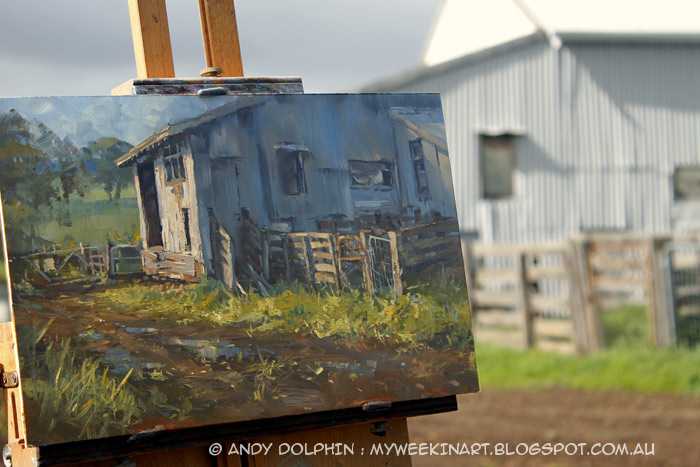
Shearing shed plein air oil painting by Andy Dolphin
Shearing shed. 
Plein air painting. 40x25cm oil on board.
© Andy Dolphin
SOLD

Those angled cast shadows, on the fence and the right-hand part of the shed, were derived straight from the thumbnail. Neither was still in that position when the sun did eventually break through. Interestingly, the scene didn't look as appealing with those shadows cast at different angles.

Since I was being "creative" I invented a couple of puddles too. The highlights in the driveway mud were created by wiping back the dark brown paint exposing some of the burnt sienna under-painting.

By the time I packed up, it was about 11:30am. Or so I assumed.

In fact, when I got back in the car to drive home, it was after 1pm. I'd been here for over four hours! I know I slow down when the clouds roll in but four hours? Ouch! Definitely something going on with that space-time continuum thing.

But at least it didn't rain.

You can see in the "must-have" location shot how the sun has come out, now that I've finished, and is now lighting up what used to be the shaded side of the shed...


Plein air oil painting, shearing shed, on location

Saturday, August 17, 2013

Early morning - plein air landscape in oil

Third update for the day.

I was up just after 7am and the sky was clear and the sun was just beginning to shed light on things. So I got my gear together and headed out for a little "early-morning" painting.

If you've been following along in the last few weeks, you know what happened next. Yes, the clouds rolled in. But I soldiered on.

I set myself up in a paddock looking towards the abandoned cottage I painted last weekend. I noticed this view yesterday afternoon and realised it would light up nicely in the early morning.

And I was right. Things were exactly as I expected, when the sun broke through the clouds.

I did a quick thumbnail while the sun was shining and committed as much of the scene to memory as I could. It was far too cloudy to risk a big painting so I grabbed a small board and set about doing a sketch.


It was cloudy most of the time, so plenty of memory was required and it rained on me, again, and it was cold (I wore my gloves again and even took a mid-painting warm-up walk) but things progressed pretty well. I spent about an hour and a half on this one, which is a bit longer than usual for a small sketch but things do slow down when the clouds roll in. I finished off the foreground and touched up a few details when I got back to the studio, so add another 15-20 minutes.

Plein air oil painting rural landscape sketch by Andy Dolphin.
Early morning, Narpyn. 
Plein air sketch. 30x25cm oil on board.
© Andy Dolphin
SOLD

I used a limited palette of ultramarine, burnt sienna and cadmium yellow deep. The lack of a true red meant that shadow tones and greys would retain an earthy hue rather than leaning toward purple. The burnt sienna under-painting shows through in a few spots too, including the warm glow in the otherwise-grey sky.

And here's the "oops, I packed up and almost forgot to take a location shot so I'll just lean it against this fence" location shot...


So now I've done eight paintings in the last few weeks and have been rained on six of those times. I think that's a record for me. Lucky I don't do watercolours.

I've checked tomorrow's forecast and apparently we're in for some more rain. So I guess I'll venture back outside and see what happens.

Paperbark - plein air landscape in oil

After some fairly dismal weather over the last few days, the sun managed to pop out for a short while yesterday afternoon.

I found a washed out winter creek line on a property not far from home and spent half-an-hour or so wandering around it, taking photos. A gnarled paperbark arching over the creek caught my attention and I decided to grab my easel and see if I could capture something in paint before the rain returned or the sun set.

It did rain on me and the sun did set, but I got something that required very little attention back in the studio, so I'm not sure who won that race.

We'll call it a draw.

Here's the finished plein air oil sketch...

Winter creek plein air landscape painting by Andy Dolphin
Narpyn paperbark, winter. 
Plein air sketch. 30x25cm oil on board.
© Andy Dolphin
SOLD

As has been the case with almost every painting I've done in the last couple of months, the sun disappeared behind clouds for most of the time I was painting. It was a fairly simple scene so it wasn't to difficult to remember where the highlights should be but I had to be a little inventive with hue and saturation.

And it was cold (by Western Australian standards, not by Moscow standards), it snowed in the nearby Stirling Range in the morning. I actually wore gloves for this one – another "first" for me. And it rained on me half-way through this painting. And it was windy so I had my backpack sitting in my easel tray to stop it blowing away. So relaxing!

I used the painting knife again on this one. I think I'm slowly getting to grips with it. It's amazing how, sometimes, it gives you detail you would never have thought to add with a brush, but which looks like it should be exactly where it is.

And here's the "how do we know you were there?" location shot, taken with a flash because it was pretty dark at this point...


By my count, I've painted at this location seven times now in the last few weeks, and it's rained on me on five of those occasions. Who said painting was relaxing?

Narpyn Creek - plein air oil landscape

We had a bit of sunshine last weekend so, naturally, I headed out to paint.

Here's the underpainting...


I got a fair way through the painting when I looked behind me and saw heavy clouds heading straight for me. Before I had time to throw everything in my back pack and fold up my easel, it was raining. And it got heavier.

I was over 100m from the nearest shelter and had to tread carefully as the paddock is very green, very uneven, very slippery - and uphill all the way. Carrying a French easel with wet painting on-board in such conditions is not the most fun a person can have in a day.

So here's how things looked when I made it to shelter in a nearby shearing shed.


I'd been standing down that valley, off to the right of the photo, when the rain hit. I was somewhat damp by now.


I plonked the almost-finished painting on an easel back in the studio, let it dry, then added a few finishing touches. Here's how it ended up.

Creek. Plein air landscape painting in oil by Andy Dolphin
Narpyn Creek.  
30x40cm oil on board.
© Andy Dolphin

Looking at it with fresh eyes, I think I need to go back and try again on a day when the sun plans to hang around a while. This one goes in "the pile". It happens.

Saturday, August 10, 2013

Cottage - plein air oil painting

I mentioned recently that I've found a new favourite painting spot. It's a farm, less than 10 minutes from home, with a history dating back to the late 1800s.

I've been given permission to do some painting around the property and have spent quite a lot of time out there over the last week and have taken a lot of photos since the weather has been less-than-forgiving and mostly not suited to painting outdoors. So far, I've managed to paint five times, and it's rained on three of those occasions.

On my first visit, I wandered around an old, derelict cottage and was captivated by its sunlit eastern face. I photographed it and studied the photos over the last week. I even did a rough Photoshop sketch of it.

Today we had clear skies again, so I headed out to the farm knowing exactly what I planned to paint. It was time to test my "contemporary impressionism" skills again.

So, without further ado, I bring you "Narpyn Cottage, winter morning"...

Narpyn Cottage, winter morning.
Plein air. 38x35cm oil on board.
© Andy Dolphin

At 38x35cm, this is probably the second-biggest plain air painting I've ever done and, at somewhere between 3.5-4 hours to complete, it took the longest, by far. I don't think it's finished yet, though.

Here's stage 1 - the under-painting...


This is a combination of washing-in and wiping-out. Although the idea is to keep things fairly loose, a lot of important questions are asked at this stage. Where are the major darks? What's warm, what's cool? Is it too centred, too high, too low? Why do people say painting is relaxing? Should I have taken up golf instead? The questions just keep coming – the same questions, every time. Some remain unanswered.

There's 15-30 minutes work here.

And here's stage 2, almost two hours in (I didn't know it had taken that long, but that's what my camera claims)...


By this time, the sun had risen pretty high and shifted across to the left, so the shadows had all changed. It was important to try and stick with my layout and not be tempted by what I was seeing in front of me. By the time I finished, the sun had moved far enough that none of these walls were sunlit.

Ordinarily, a thumbnail sketch is a useful reference for dealing with the changing-shadows problem but, in this case, I'd had the image stuck in my head for a week, so I didn't do a thumbnail.

I used the palette knife quite a bit in this painting - for adding and removing paint. That's a whole new world for me. Until this week, I've usually only used a palette knife for mixing paint or, more often, cleaning my brushes - or, sometimes, deleting sections of paintings, or deleting entire paintings. I still have to tame the knife, but this property will offer me a lot of opportunities.

I was exhausted, mentally, when I got home. So I had some lunch and a nanna nap. Then I got up, had coffee and went back for more before sunset. I didn't have much time so I almost literally threw this one together...

Evening, winter.
Plein air sketch. 34x30cm oil on board.
© Andy Dolphin

There's just less than an hour's work here, and much of that time was spent on the two sheds. Actually, most of it was probably spent on the white shearing shed. So many shades of "white"!

When I put the brushes down, the sun had set and the entire scene was in shadow. But when I turned around, the sky was a brilliant orange-violet. Five minutes later, it was all gone.

It was great to have a day with mostly-clear skies.

Friday, August 2, 2013

Narpyn cottage - plein air oil sketch

This painting represents a very different approach for me. It's something I've wanted to do for a long time but it's not always possible to get close enough to a subject.

It is inspired by the likes of Richard Schmid, whose work I discovered in an issue of International Artist Magazine around 12 years ago, Harley Brown, whose book "Eternal Truths" provided guidance to me almost ten years ago, and Tibor Nagy, whose work I discovered online just a few years ago. I've long-admired their combined loose-tight style, where focused impressionism sits atop an abstract foundation. It's something I've been drifting toward for the last couple of years, especially with my plein air works.

This abandoned and somewhat derelict cottage provided a perfect opportunity for me to develop my style further.

Here's the thumbnail...


As you can probably see, it is all about the hard shadow cast across the wall of the house.

Here's the under-painting. The finished piece was mostly going to be cool greys but the cottage had a sort of organic, rustic charm, so I wanted a warm, earthy feeling to flow through.


I was soon challenged by the sun disappearing behind clouds,before I'd locked enough of the painting in place. In fact, it rained on me half-way through.

When the clouds roll in and the sunlit areas of the subject are cast into shadow, the details that used to be hidden away in dark shadow areas suddenly reveal themselves. It's easy to start fidgeting when this happens and unnecessary detail can creep into the painting.

And indeed, that's exactly what happened (you'd think I'd learn by now to just walk away or something, but no).

My original intent was to create a very loose, high contrast sketch with detail only around the focal point, the window. But I played with it while I waited for the sunlight to return and it tightened up more than I'd planned and I lost almost all the contrast. One of the major pieces of information I lost without the sunlight was just how the leafless, woody creeper was supposed to look. My thumbnail shows that it was probably very striking, and mostly brightly lit, but I no longer had any reference and, without the sun shining, it was just a drab collection of twisted grey sticks. I had to invent light and shadow for it.

But here it is. I popped it in a spare frame, as this can often help to identify issues (I think this one mainly needs more brightness on the sunlit wall)...

 Narpyn cottage. 
Plein air sketch. 30x25cm oil on board. 
© Andy Dolphin

I regard this one as little more than an exercise – not good enough to sell but not bad enough to scrape. I will go back and try this same painting again when the weather is more stable. I might even throw this one back up on the easel and see what lessons I can drag out of it by making changes.

Thursday, April 18, 2013

Rural road - plein air landscape in oil

Despite some less-than-spectacular weather, I have actually been doing some painting among all my grumbling about the Great Southern Art Award.

Last weekend, with grey skies from horizon to horizon, I went for an aimless drive down some of the farming roads around here.

I found a pleasant little spot where I could park well off the road and safely stand to paint. So that's what I did.

One advantage of grey skies is that the light doesn't change as drastically as it does on clear days, so you can take your time getting things right. One disadvantage of grey skies is that the light doesn't change as drastically as it does on clear days, so you tend to take your time and lose some of the spontaneity that occurs in faster paintings.

Since I almost never paint on grey days, I used this as another opportunity to see if I could change that habit. I  spent around two hours on this one I think. I lost track of time and had to stop for a while as a farmer drove his sheep across the road right in front of me. Plus the scene disappeared every 15 minutes or so as cars and trucks went past, filling the air with dust.

plein air landscape in oil by andy dolphin
(Rural road. Plein air sketch. 30x25cm oil on board. © Andy Dolphin)

Sorry, I didn't get a location shot.

Sunday, March 24, 2013

Plein air clouds in oil

I headed back down to the coast today, hoping the heavy cloud would clear. It didn't.

I tossed up whether to paint a seascape despite the lack of sunlight but it just wasn't inspiring. However, looking out  to the horizon, from a high vantage point above Lowlands Beach, I did find some interest in the large cumulus clouds. So I decided to paint them instead.

Plein air clouds painting in oils by Andy Dophin
(Lowlands Clounds. Plein air sketch. 20x30cm oil on board. © Andy Dolphin)

Since I almost never paint plein air clouds in any amount of detail, I treated this as an exercise.

Clouds are constantly changing and you may not realise just how fast they change until you try to paint them. Each time you look up, the bit you were just painting is different. It could be a different shape or size or it could change from sunlit to shaded, or vice versa. It might even disappear completely, either through evaporation or being hidden behind another cloud.

To deal with the changes, a lot of commitment occurs in the very first brushstrokes. I laid down a quick outline of the major cloud mass then quickly blocked in some shadow areas, leaving the sunlit areas untouched. I threw the ocean in as a thin wash, just to hide the primed board, then painted the hazy area between the base of the clouds and the horizon. By now the clouds shapes had all changed dramatically. Sticking with my initial layout, I added the clear sky area, sculpting it around the clouds. Then I added the highlight area.

With the main areas laid in, I looked along the horizon for banks of cloud with similar shapes to those in my painting and used these as a guide for modelling my light and shadow masses.

Thursday, March 7, 2013

Oil and water don't mix!

Ever since I started painting, I've favoured scenes with sunlight and shadow. I love the hard contrasts of dark against light, warm against cool. And it's not that it makes painting easier, it just happens to be what catches my eye even when I'm not actively seeking out things to paint.

On the one or two occasions where I've painted on overcast days, the results have been less than spectacular.

And yet, I see other artists turn out beautiful paintings on what can best be described as dreary days. Their skies are grey, their landscape is grey, nothing is bright and shiny - but the end results of their efforts are very appealing.

With autumn here and the clouds already rolling in, I decided that this year I was going to push myself to paint outdoors on overcast days. With that in mind, I headed out to the coast yesterday afternoon to see if I could find some grey-day inspiration. I finally found something that looked promising and started to paint.

Ten minutes in, it started to rain. It wasn't cold so I just kept painting.

Here's the palette after about 20 minutes. The painting itself had almost as much water sloshing around on it.

Plein air oil painting in the rain. Palette.

Then it stopped raining for a while, before starting to rain again. "Oh, this is fun", I thought to myself.

It's actually lucky that oil ad water don't mix, otherwise my painting would have little more than a puddle on the shell-grit beach. As it was, the oil repels the water just enough to allow you to keep working. But it was messy and it took a bit of effort to get paint off the palette, onto the brush and then onto the painting.

Anyway, after a little over an hour, I ended up with something that shows promise. Here's the location shot taken just before the next lot of rain arrived.

Cloudy plein air seascape in oil by Andy Dolphin

And here's the finished piece. This quiet little beach offered an interesting shape, a range of textures and colours and some stark tonal contrasts even on this very cloudy day.

Cloudy plein air seascape in oil by Andy Dolphin
 Near Quaranup. 
Plein air sketch. 
30x25cm oil on board. 
© Andy Dolphin
SOLD

I took this photo this morning. If you click to enlarge the pic, you'll see some dried-out rain drops are still there.

So, it's not fantastic but it is something. I'll mess with it a bit and see what I can salvage from it.

Thursday, September 6, 2012

Plein air seascape sketch

Green Islands, Torndirrup, Albany. Storm. By Andy Dolphin
Green Islands, Albany. Photo by Andy Dolphin.

It's been a pretty bleak week, so far, weather-wise. Big storms were predicted for Monday and Tuesday and, while we were spared anything too nasty, there has been a lot of heavy rain and some fair gusts of wind (there was also a rumour of snow on the Stirling Range but I think it was a case of "blink and you miss it").

I'd hoped to go painting at Torndirrup on Monday afternoon but it was a wash-out and, along with the non-stop rain, it was far too windy to risk wandering around out there. I didn't even make the journey to see how things were looking.

I did manage to get out there yesterday afternoon (Wednesday), despite continuing rain, to witness the after-effects of the storms. I hung around taking photos and video for about 20 minutes but when I wasn't getting rained on, I was getting showered with salt spray! The sea was definitely pounding, but there was no chance any painting was going to happen. The photo above tells the story - it was amazing and miserable at the same time.

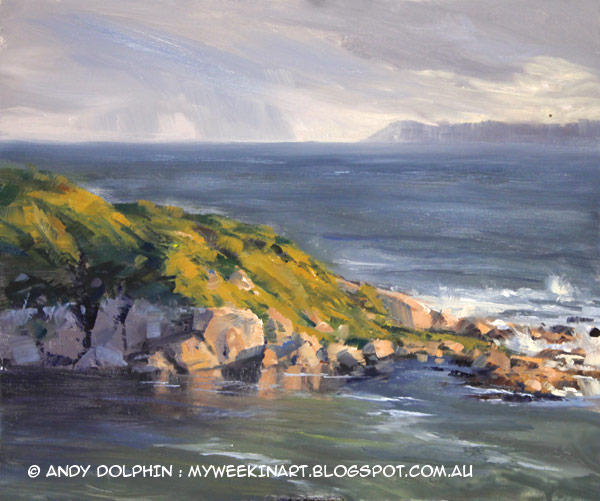
Here's the painting I did on Sunday, a very different day, as seen in my previous plein air seascape article.

Plein air seascape sketch, Albany, in oils by Andy Dolphin
(Heavy Seas. Sketch. 30x25cm oil on board. © Andy Dolphin)

I used a fairly limited palette of ultramarine, cerulean, permanent crimson, burnt sienna and cad yellow light. I wanted purplish shadows to complement the yellow light and the ultramarine and crimson delivered this. I needed the cerulean to capture the very clean green-blue in the foreground wave and in the splash - this colour was very evident during this session. Burnt sienna was on the palette as a time saver, so I could lay in some quick darks without messing around with mixing tertiary colours (ultramarine, crimson and yellow).

I threw the paint on in large patches: dark brown for the rocks, clean blue-grey for the foam area, dark green-grey for the open water and a warm yellow for the sky, with purply-greys worked into it for clouds. With the basic areas established, I added some general mid-tones to separate light from shadow. From this stage it was a matter of watching the ocean and adding and altering bits until I decided no more was needed. I painted for about one hour and quite a bit of that time was spent staring, waiting for the right shapes to "repeat" themselves

There's quite a bit to work work from here for a larger painting.

I'm hoping to get back there tomorrow and see what else this spot can teach me. Depending on conditions, and emotions, I might focus on the foreground rocks and see if I can tame them.

Monday, September 3, 2012

Plein air seascape - Albany

Photo, Green Islands, Torndirrup, Albany, Andy Dolphin
Green Islands, Albany. Photo by Andy Dolphin.

Date: Sunday, September 2, 2012
Weather Forecast: Fine and mild.

It was a beautiful day in Mt Barker yesterday so I took the opportunity to revisit my current favourite plein air painting spot in Torndirrup National Park, Albany (Western Australia).

Mt Barker is 50km from the coast and Torndirrup is a 45-minute drive away. There's never any guarantee the weather will be remotely the same when I get there. But yesterday it was close-to-perfect when I arrived. It was warm and the breeze was light, so I could wear my brimmed hat to keep the sun out of my eyes, instead of my beanie (my ears ache when it's cold). And I didn't need to wear a jacket!

Despite the mild weather, and although the sea looked calm out to the horizon, there was one hell of a swell thumping into shore. I spent a pleasant couple of hours watching the sea, taking photos and painting - and being amazed by the sheer force of some of the breakers.

This painting was done about the same time of day as Wednesday's painting at the same place. I've chosen a slightly different position so that I'm not looking so directly into the setting sun for this one. I wanted good lighting but not glare. I also went in with a better idea of what I wanted the end result to be, before I began (I've observed this spot quite a lot over the last couple of months). I just had to look for the information to make it work and try not to get distracted by other amazing things that happen in the chaos of breaker after breaker.

Here's the compulsory "I really was there when I painted this" shot. You can get some idea of how bright the light was toward the end. I did a little more work after this photo was taken.

plein air seascape in oil by Andy Dolphin on location

I approached this one, initially, as a very-quick-sketch, throwing large patches of base colour into the major tonal areas. Then I worked over all areas bringing them to some level of completion. It's still pretty loose though.

I'll post a proper pic of the painting when I get a chance to take a photo in decent light. And here it is plein air seascape sketch in oils.

These plein air works are a part of my evolution of a seascape in oil series. All the experience I gain from painting on location, in various conditions, will feed in to the end result of that effort. I'll be going back to the same spot a few more times yet. I was hoping to get there today but life, and a rather large storm, got in the way.

And, once again, the photo at the top of the article is how the place looked while I was packing up. It really is a shocking way to live. 

Wednesday, August 22, 2012

Storm-tossed seas

Green Island, Albany, on a stormy day. Andy Dolphin.
Green Islands, Albany. Photo by Andy Dolphin.

Date: Wednesday, August 22, 2012
Weather Forecast: Severe Weather Warning

With severe weather forecast, I made the decision that I would head back to my favourite bit of Albany coastline this afternoon. I've seen it in the lead up to a storm before, but not during one.

I knew it wouldn't be pretty but I packed my paints and easel up, just in case there was an opportunity for some plein air action.

The weather bureau don't always get it right.

But they were right this time. All hell was breaking loose along the exposed sections of coastline. The spray from the breakers smashing against the rocks was non-stop and drenching - and the wind carried it long distances, like right across the car park, 100m away, and all over my car. And it wasn't the usual coastal mist, this was like short bouts of heavy rain.

Here's a plein air painting I did a week ago...


And here's what that spot looked like today, from a slightly lower viewpoint...


Painting was obviously off the menu today and I had to settle for photos and video. My poor camera was copping it and I had to keep wiping the lens on my jumper to get rid of the spray (I have a cheap UV filter on the lens for this very reason. Lenses are too expensive to mistreat. I probably should carry a lint-free cloth though.)

The Gap, Albany, in a storm. Andy Dolphin.

Can you see the person standing on the viewing platform in the photo above (click the pic for a bigger image)? This is a spot known as The Gap and the ocean is some 25m below the viewing platform. There's a pretty scary amount of force behind that wave! And the wind at the platform was phenomenal.

Cable Beach, Albany, in a storm. Andy Dolphin

Above is Cable Beach, a "sheltered" bay near The Gap. A few days ago the water was crystal clear, there were small fishing boats visible way out to sea and I was watching dolphins leisurely patrolling the shore at this very spot.  The only dolphin seen there today was me!

There's a 100 tonne boulder on the beach, just out of shot. Apparently it washed up one day in a storm - a much bigger storm than today's.

Salmon Holes, Albany, in a storm. Andy Dolphin

Above and below are photos of Salmon Holes, a deadly beach near the end of the Torndirrup Peninsula. People often stand on that sloping rock in the left foreground in the hopes of catching fish. Some never get to go home because, even on calm days, massive swells wash a long way up, along and back down it. My fish comes from a shop.

Salmon Holes, Albany, in stormy seas. Andy Dolphin

In all, I used up over 10Gb of my SD card this afternoon - over 400 photos and videos in just under four hours (although some are just blurry blobs because of the water-covered camera lens). I packed up when it got too dark. And did I mention it was cold? It was cold. My cheeks were burning from the chill. The things I do for this blog!

But I loved every minute of it. We'll see if any paintings result from the effort.

Thursday, August 16, 2012

Plein air seascape in oil

Green Island, Albany. Andy Dolphin.
Green Islands, Albany. Photo by Andy Dolphin.

Date: Thursday, August 16, 2012
Weather Forecast: Cold

The forecast for today was cold and cloudy. As it turned out, that was an understatement.

Despite the weather prediction, I had made the decision to return to my favourite seascape spot near Albany, Western Australia. When I arrived, it was a little bleak and blustery so I went for a walk to see how things looked. The wind was straight off the Antarctic.

But it wasn't raining, and the surf was pumping, so I grabbed my French easel and found a spot where I thought I might be a little sheltered from the wind. I chose to sit on a rock, to further protect myself. This was to prove a mistake - it was soon uncomfortable. Note to self: "stand up next time".

I sat painting for about one and a half hours. During that time the sun shone through exactly never. In some ways this was good because the scene before me never really changed. When there's no sun, there's no shadows to move as time goes by. And when the sunlight comes and goes, it can make painting difficult as the scene changes dramatically each time.

As I was finishing, I met a lovely bunch of people on holidays. Many photos were taken of each of them with my painting, including a group shot with me. Here's where things ended up before I headed back to the warmth of my car. This is 255mm (10") wide.

Plein Air seascape in oils, Albany. Andy Dolphin.

This section of coastline is deadly. There are warnings everywhere - although when I was here last week, a woman walked right down to the water's edge, got very wet, and was lucky to walk back up again. I've seen the spot where she stood get swamped with deep water from big waves on occasion. She was hit by a relatively small wave.

On grey days like today, this bay looks every bit as threatening as it's reputation.

Those breakers hitting the cliff face on the far side literally explode. The spray can hang in the air for four or five seconds, like it's in slow motion. They are big waves. Sometimes an incoming wave meets one bouncing back off the shore and they explode unexpectedly in mid-water. It can get pretty crazy out there!

I've watched, photographed and videoed those explosions many, many times and today seemed like the perfect day for painting them.

Here's a bit of detail from the focal point, so you can see the brushstrokes. Most of the work was done using two flat synthetic brushes with some fine detail added at the end with a rigger.

Plein Air seascape in oils, Albany. Detail. Andy Dolphin.

And here is the "yes, I really painted this on location" shot.

Plein Air seascape on location. Andy Dolphin.

I had planned to do two sketches on the one board, like I did when I painted here on Saturday, but it got colder while I was painting today and it felt like it was going to rain. So I went home.

I'll continue with my "Genesis of a Seascape in oil" series soon.