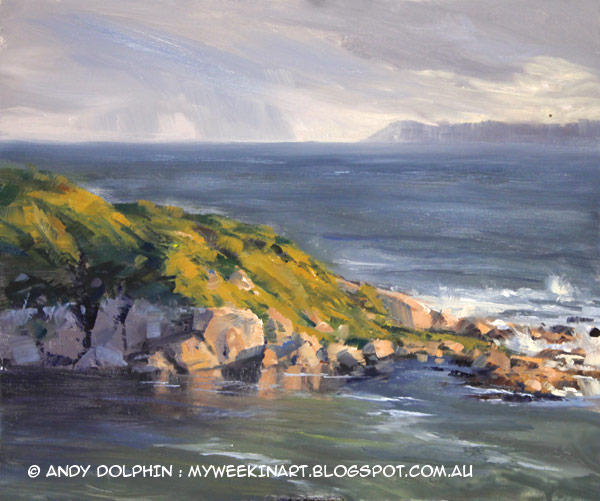
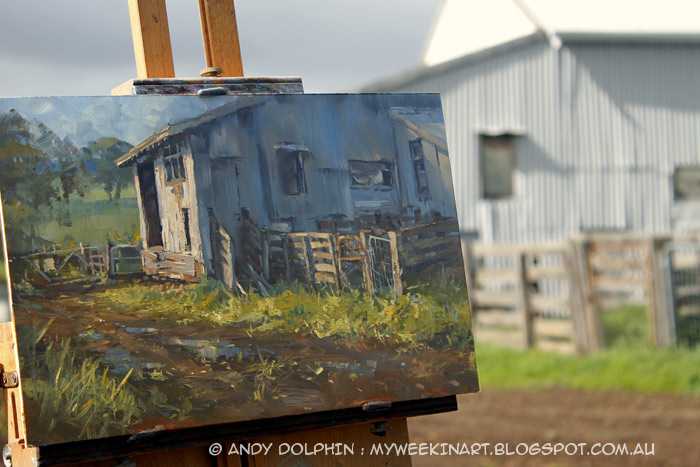
I've uploaded a new plein air video showing the production of this landscape painting.
You can view the video on Youtube here and you can read more on my other blog here.
Showing posts with label limited palette. Show all posts
Monday, October 2, 2017
Sunday, July 27, 2014
Brass pitcher - oil still life
I bought this stumpy brass pitcher a few weeks ago at the local secondhand shop. I've been itching to paint it ever since.
I polished it last weekend and set it up today with some synthetic flowers and grapes.
I consider this one just unfinished as seen here. I had less time than expected and didn't get to spend as long as I would have liked on some areas. I'll take another look at it later in the week and see if I can tidy it up a little.
I am really enjoying the "brass on red" series. This is the fourth one so far and I've been surprised by where the red reflects each time. This one was particularly interesting as the pitcher reflects itself at the base and features alternating upward and downward facing surfaces. It certainly presented a challenge.
I polished it last weekend and set it up today with some synthetic flowers and grapes.
Short pitcher with flowers - stage 1
25x30cm oil on board.
© Andy Dolphin
I consider this one just unfinished as seen here. I had less time than expected and didn't get to spend as long as I would have liked on some areas. I'll take another look at it later in the week and see if I can tidy it up a little.
I am really enjoying the "brass on red" series. This is the fourth one so far and I've been surprised by where the red reflects each time. This one was particularly interesting as the pitcher reflects itself at the base and features alternating upward and downward facing surfaces. It certainly presented a challenge.
Labels:
brass pitcher,
floral,
limited palette,
oil painting,
still life
Sunday, May 11, 2014
Flowers with brass vase - still life in oil
My latest still life painting features another op-shop treasure. I tried several different arrangements using this round-bottomed, squat brass vase, and finally settled on this one.
As with previous paintings, the flowers are synthetic. This allows me time to experiment with arrangements without worrying about the flowers succumbing to the heat from the lamp. In fact, I can set things up one day and then start the painting days, or even weeks, later without everything wilting and dying.
I'm more interested in composition and colour than the accurate portrayal of particular species of plants, so I have no need for living specimens at this stage.
Interestingly, the most difficult part of this painting was polishing the vase. It was very tarnished but had a lacquer coating that was impervious to lacquer thinners and had to be removed with lots of elbow grease and car polish.
Flowers with brass vase
25x30cm oil on board.
© Andy Dolphin
As with previous paintings, the flowers are synthetic. This allows me time to experiment with arrangements without worrying about the flowers succumbing to the heat from the lamp. In fact, I can set things up one day and then start the painting days, or even weeks, later without everything wilting and dying.
I'm more interested in composition and colour than the accurate portrayal of particular species of plants, so I have no need for living specimens at this stage.
Interestingly, the most difficult part of this painting was polishing the vase. It was very tarnished but had a lacquer coating that was impervious to lacquer thinners and had to be removed with lots of elbow grease and car polish.
Wednesday, March 5, 2014
Miniature Chinese vase still life
I painted this little still life a couple of days ago.
The miniature Chinese-style vase was purchased two weeks ago at a local op-shop (thrift shop) and stands around 8cm tall. The flowers are synthetic and were picked up at a garage sale for two dollars.
I used a new full-spectrum, 6400K compact fluorescent bulb to light the set-up on this one. Full spectrum lamps give a much cooler, true-white light compared to other globes. It took a bit of searching to find a bulb but the local lighting shop tracked one down for me for $9, which is much cheaper than I'd seen quoted elsewhere for similar bulbs.
I used the same lamp to add extra light in the studio while photographing the painting and am very pleased with the result. I did hardly any adjusting in Photoshop at all this time. I'm going to look for a couple of lamp stands and get some more bulbs to make that process even better.
I did shoot some video of progress on this one. Hopefully it will be good enough to edit together and put on Youtube.
WOOLORAMA:
I completely forgot to mention that this weekend (Friday 7th & Saturday 8th March) is Wagin Woolorama weekend. I took out first prize last year and have entered three paintings again this year.
Fingers crossed.
If you are in the region on Saturday, or feel like a day out (it's about two and a half hours from Perth), I might see you there. Just follow the map to Wagin then follow everyone else when you get there.
Miniature Chinese vase
21x25cm oil on board.
© Andy Dolphin
The miniature Chinese-style vase was purchased two weeks ago at a local op-shop (thrift shop) and stands around 8cm tall. The flowers are synthetic and were picked up at a garage sale for two dollars.
I used a new full-spectrum, 6400K compact fluorescent bulb to light the set-up on this one. Full spectrum lamps give a much cooler, true-white light compared to other globes. It took a bit of searching to find a bulb but the local lighting shop tracked one down for me for $9, which is much cheaper than I'd seen quoted elsewhere for similar bulbs.
I used the same lamp to add extra light in the studio while photographing the painting and am very pleased with the result. I did hardly any adjusting in Photoshop at all this time. I'm going to look for a couple of lamp stands and get some more bulbs to make that process even better.
I did shoot some video of progress on this one. Hopefully it will be good enough to edit together and put on Youtube.
WOOLORAMA:
I completely forgot to mention that this weekend (Friday 7th & Saturday 8th March) is Wagin Woolorama weekend. I took out first prize last year and have entered three paintings again this year.
Fingers crossed.
If you are in the region on Saturday, or feel like a day out (it's about two and a half hours from Perth), I might see you there. Just follow the map to Wagin then follow everyone else when you get there.
Sunday, February 23, 2014
Blue vase - still life in oil
Over the last few weeks, I've been visiting op-shops and garage sales and picking up interesting odds and ends for use in still life paintings.
This blue vase was one of the things I collected. It is a very dark, yet intense blue with a gold and silver foil pattern on one side. The small cream-coloured ceramic pot is one I picked up at an op-shop years ago. The flowers are synthetic, but if you don't tell anyone, then I won't mention it either.
I almost never do still life paintings but I want 2014 to be the year where that changes. This painting is the first step in that journey. I started it at 8pm yesterday when the mood suddenly hit, and I was done by 10pm, with a short break half-way through. I had already set it up the day before.
I don't consider it finished but I'm happy with the overall feeling of it as a "proof of concept".
The palette is quite limited: ultramarine, permanent crimson, cad-yellow light, yellow ochre and burnt sienna.
The lighting for this was supplied by an old domestic compact fluorescent globe but I got a new full-spectrum compact fluoro yesterday that I hope to use in future.
This blue vase was one of the things I collected. It is a very dark, yet intense blue with a gold and silver foil pattern on one side. The small cream-coloured ceramic pot is one I picked up at an op-shop years ago. The flowers are synthetic, but if you don't tell anyone, then I won't mention it either.
Blue vase
25x30cm oil on board.
© Andy Dolphin
I almost never do still life paintings but I want 2014 to be the year where that changes. This painting is the first step in that journey. I started it at 8pm yesterday when the mood suddenly hit, and I was done by 10pm, with a short break half-way through. I had already set it up the day before.
I don't consider it finished but I'm happy with the overall feeling of it as a "proof of concept".
The palette is quite limited: ultramarine, permanent crimson, cad-yellow light, yellow ochre and burnt sienna.
The lighting for this was supplied by an old domestic compact fluorescent globe but I got a new full-spectrum compact fluoro yesterday that I hope to use in future.
Thursday, November 14, 2013
Spring was here!
It took a while to arrive, but spring did show itself for a few days recently. But, with summer just two weeks away, the grey weather has returned.
I bought myself some new brushes recently. I've been using flat synthetic brushes for the last couple of years but now I'm returning to good old, tried and tested hog bristles. The synthetics started to get a little bit too frustrating as they loose shape fairly quickly, even with careful washing and storage. They also occasionally refused to let go of the paint when making a stroke and I found myself adding more and more turps or medium to try and get things to work properly. There were times where this seriously slowed things down and time is one commodity the plein air painter rarely has enough of.
I might write a bit more about that once I've tamed my new bristles.
The continuing grey weather has given the opportunity to spend a little time in the studio and this week I did something I've rarely done in the past - I painted over some plein air sketches that I felt needed a lift in order to become frame-worthy.
The first one is a painting I did a while ago. It was painted very late in the day and the light faded fast. I used a "pre-mix" approach where almost all the colours are mixed on the palette before any colour is applied to the painting surface.
I mixed a few main colours for the trees - shadows and highlights, warms and cools - two for the hills, a few for the ground and two for the clouds, plus some blues for the sky. This was a first for me and I can see some potential advantages in the method when the light is changing fast, but I'm not sure how often I'll use it. What I generally tend to do is use a mix-and-apply approach in combination with pre-mixes for some specific areas where I want to lock-in colours at a given time.
I liked the general structure of this one but the major forms were a little fractured and it lacked punch. I particularly wanted the sheep to catch a bit more of the evening sunlight. So I carefully scraped back the dry paint with a new palette knife, to get rid of the biggest ridges, and got to work. Here's the result...
My second re-do was first just two weeks ago. It was a perfect afternoon and I hadn't looked at this location before. The distant air was thick with sunlit vapour and almost swallowed the Porongurup Range less than ten kilometres away.
This was the first time I used my new brushes and was very pleased with the process. Here's the painting as it stood when I packed up...
...and a location shot, of course, for people who like that sort of thing...
And here it is after I scraped back the ridges and painted over it in the studio.
I feel the end result does a far better job of capturing the glowing atmospheric light that attracted me in the first place. I also reduced some of the mid-ground clutter by deleting what appeared to be a second dam behind the one where the cows are standing.
In both cases, the major change I wanted to make was to add more warmth. I prefer bright, warm paintings but it can be easy to lose vibrancy when you're standing on the side of the road and painting quickly.
Both paintings were done - and re-done - using a three-colour palette.
I bought myself some new brushes recently. I've been using flat synthetic brushes for the last couple of years but now I'm returning to good old, tried and tested hog bristles. The synthetics started to get a little bit too frustrating as they loose shape fairly quickly, even with careful washing and storage. They also occasionally refused to let go of the paint when making a stroke and I found myself adding more and more turps or medium to try and get things to work properly. There were times where this seriously slowed things down and time is one commodity the plein air painter rarely has enough of.
I might write a bit more about that once I've tamed my new bristles.
The continuing grey weather has given the opportunity to spend a little time in the studio and this week I did something I've rarely done in the past - I painted over some plein air sketches that I felt needed a lift in order to become frame-worthy.
The first one is a painting I did a while ago. It was painted very late in the day and the light faded fast. I used a "pre-mix" approach where almost all the colours are mixed on the palette before any colour is applied to the painting surface.
I mixed a few main colours for the trees - shadows and highlights, warms and cools - two for the hills, a few for the ground and two for the clouds, plus some blues for the sky. This was a first for me and I can see some potential advantages in the method when the light is changing fast, but I'm not sure how often I'll use it. What I generally tend to do is use a mix-and-apply approach in combination with pre-mixes for some specific areas where I want to lock-in colours at a given time.
Porongurup Sheep.
Plein air sketch. 35x25cm oil on board.
© Andy Dolphin
I liked the general structure of this one but the major forms were a little fractured and it lacked punch. I particularly wanted the sheep to catch a bit more of the evening sunlight. So I carefully scraped back the dry paint with a new palette knife, to get rid of the biggest ridges, and got to work. Here's the result...
Porongurup Sheep.
35x25cm oil on board.
© Andy Dolphin
My second re-do was first just two weeks ago. It was a perfect afternoon and I hadn't looked at this location before. The distant air was thick with sunlit vapour and almost swallowed the Porongurup Range less than ten kilometres away.
This was the first time I used my new brushes and was very pleased with the process. Here's the painting as it stood when I packed up...
Takenup Cattle.
Plein air sketch. 35x25cm oil on board.
© Andy Dolphin
...and a location shot, of course, for people who like that sort of thing...
And here it is after I scraped back the ridges and painted over it in the studio.
Takenup Cattle.
35x25cm oil on board.
© Andy Dolphin
I feel the end result does a far better job of capturing the glowing atmospheric light that attracted me in the first place. I also reduced some of the mid-ground clutter by deleting what appeared to be a second dam behind the one where the cows are standing.
In both cases, the major change I wanted to make was to add more warmth. I prefer bright, warm paintings but it can be easy to lose vibrancy when you're standing on the side of the road and painting quickly.
Both paintings were done - and re-done - using a three-colour palette.
Labels:
clouds,
issues,
landscape,
limited palette,
oil painting,
plein air,
sunset,
weather
Friday, September 20, 2013
Composition: plein air seascape in oil
When painting on location, there often isn't time to mess around with composing a scene.
If you have plenty of light left in the day, it can be very handy to knock out a couple of one-minute thumbnail sketches to see what presents itself as a strong composition. But as sunset draws near, those couple of minutes become precious. And you don't necessarily have a lot of different shaped boards to choose from when you're out and about so your composition options are limited from the outset.
This evening I headed back to the coast (almost 70km away) to see if I could do another cloud painting. We've had heavy cloud all day, not ideal conditions for painting either clouds or sunlight, but I decided to take the chance.
I arrived at Mutton Bird Beach about an hour-and-a-half before sunset and looked around for possible paintings. I did a few thumbnails but the light was dreadful so I continued looking around the area since I've not spent much time there before.
After walking a couple of kilometres down a four-wheel-drive track, and finding a spectacular location for future paintings, I headed back to the car park about half-an-hour before sunset.
The sky had cleared dramatically and Shelter Island was almost-glowing in the evening light. I knew it wouldn't last.
I quickly set up my easel, grabbed a board and began painting as soon as I could. Composition was the least of my concerns, I just wanted to record the sunlight. I didn't even stop to take a photo to use as a reference later, if I needed it.
I wanted to get rid of the white of the board so I could lay in some of the sunlight colours fairly accurately. I washed in major tones with paint so thin it was like watercolour - it's faster that way. Then I mixed up a couple of warm colours for the sunlit shrubs and rocks and roughed out those areas.
The island enjoyed sunlight for about five minutes after I began painting then the sun dropped behind a bank of clouds. With the sunlit image pretty clear in my mind, I continued painting even though everything was now in shadow.
In some respects, it was probably handy that the sunlight had gone because I wouldn't be teased by the scene changing colour every couple of minutes, as happens at that time of the day, and I could stick with the colour decisions I'd already locked in. I also had to not be distracted by the amazing stuff going on in the western sky (it was a gorgeous sunset).
I packed up when I realised it was so dark, I couldn't really tell what colour I was using anymore.
Palette: French ultramarine, cadmium scarlet, cadmium yellow light, titanium white.
The painting is pretty rough. Some of the paint is so thin, I don't think it could be considered archival, so I can't sell it. I also think the composition is pretty boring. But I really like the main area of light and shade so I took a quick photo and messed around in Photoshop to see what compositional possibilities there were.
I particularly like the intimacy of option number two and think I might head back to the location with that composition in mind as my starting point. And, with half the problem already solved, I could probably do a larger painting and take a little more time by starting earlier in the day.
Over the last couple of years, my attitude to plein air work has changed - and continues to change. I used to only paint if the light was perfect and likely to remain stable and if I was pretty sure I'd get a finished painting from a session. I'd usually spend two hours or more on one painting on location.
These days, I'm forcing myself to be more adventurous. I head out when it's cloudy, I start paintings late in the day when stable light is not just unlikely, it's impossible. I paint fast and I end up with whatever I end up with. Sometimes I get a result that's worth framing, sometimes I need to do some touching-up in the studio for a frameable result and other times I scrape the painting, or let it dry then throw it in the corner, with all the other "could-a-beens".
Quite a few of the paintings I've posted on this blog are in that pile because the blog isn't about great art but the pursuit of art. I'm pretty fussy about what I actually let out of the door and into the market place.
But the "failures" still have value, even if it's just from the act of getting out and painting - and that is possibly the most valuable part of the experience. It's taken me a long time to realise just how important it is to just get out there and paint and "bugger the consequences".
Twelve months ago, or even six months ago, I would not have thrown the easel in the car on a day like today. I would have looked out at the grey sky and decided to give painting a miss. As it turned out, I took the chance, went for the drive and had an amazing afternoon.
I still struggle with painting when there's no clear sunlight and shadow, but that can be next year's project.
If you have plenty of light left in the day, it can be very handy to knock out a couple of one-minute thumbnail sketches to see what presents itself as a strong composition. But as sunset draws near, those couple of minutes become precious. And you don't necessarily have a lot of different shaped boards to choose from when you're out and about so your composition options are limited from the outset.
This evening I headed back to the coast (almost 70km away) to see if I could do another cloud painting. We've had heavy cloud all day, not ideal conditions for painting either clouds or sunlight, but I decided to take the chance.
I arrived at Mutton Bird Beach about an hour-and-a-half before sunset and looked around for possible paintings. I did a few thumbnails but the light was dreadful so I continued looking around the area since I've not spent much time there before.
After walking a couple of kilometres down a four-wheel-drive track, and finding a spectacular location for future paintings, I headed back to the car park about half-an-hour before sunset.
The sky had cleared dramatically and Shelter Island was almost-glowing in the evening light. I knew it wouldn't last.
I quickly set up my easel, grabbed a board and began painting as soon as I could. Composition was the least of my concerns, I just wanted to record the sunlight. I didn't even stop to take a photo to use as a reference later, if I needed it.
I wanted to get rid of the white of the board so I could lay in some of the sunlight colours fairly accurately. I washed in major tones with paint so thin it was like watercolour - it's faster that way. Then I mixed up a couple of warm colours for the sunlit shrubs and rocks and roughed out those areas.
The island enjoyed sunlight for about five minutes after I began painting then the sun dropped behind a bank of clouds. With the sunlit image pretty clear in my mind, I continued painting even though everything was now in shadow.
In some respects, it was probably handy that the sunlight had gone because I wouldn't be teased by the scene changing colour every couple of minutes, as happens at that time of the day, and I could stick with the colour decisions I'd already locked in. I also had to not be distracted by the amazing stuff going on in the western sky (it was a gorgeous sunset).
I packed up when I realised it was so dark, I couldn't really tell what colour I was using anymore.
Shelter Island.
Plein air sketch. 30x25cm oil on board.
© Andy Dolphin
Palette: French ultramarine, cadmium scarlet, cadmium yellow light, titanium white.
The painting is pretty rough. Some of the paint is so thin, I don't think it could be considered archival, so I can't sell it. I also think the composition is pretty boring. But I really like the main area of light and shade so I took a quick photo and messed around in Photoshop to see what compositional possibilities there were.
I particularly like the intimacy of option number two and think I might head back to the location with that composition in mind as my starting point. And, with half the problem already solved, I could probably do a larger painting and take a little more time by starting earlier in the day.
Over the last couple of years, my attitude to plein air work has changed - and continues to change. I used to only paint if the light was perfect and likely to remain stable and if I was pretty sure I'd get a finished painting from a session. I'd usually spend two hours or more on one painting on location.
These days, I'm forcing myself to be more adventurous. I head out when it's cloudy, I start paintings late in the day when stable light is not just unlikely, it's impossible. I paint fast and I end up with whatever I end up with. Sometimes I get a result that's worth framing, sometimes I need to do some touching-up in the studio for a frameable result and other times I scrape the painting, or let it dry then throw it in the corner, with all the other "could-a-beens".
Quite a few of the paintings I've posted on this blog are in that pile because the blog isn't about great art but the pursuit of art. I'm pretty fussy about what I actually let out of the door and into the market place.
But the "failures" still have value, even if it's just from the act of getting out and painting - and that is possibly the most valuable part of the experience. It's taken me a long time to realise just how important it is to just get out there and paint and "bugger the consequences".
Twelve months ago, or even six months ago, I would not have thrown the easel in the car on a day like today. I would have looked out at the grey sky and decided to give painting a miss. As it turned out, I took the chance, went for the drive and had an amazing afternoon.
I still struggle with painting when there's no clear sunlight and shadow, but that can be next year's project.
Labels:
limited palette,
oil painting,
plein air,
seascape,
sunset,
tips,
weather
Spring: plein air cloudscape in oil
Earlier this year I decided my next major project was to be plein air clouds.
Clouds are sods of things to paint on location because they move much faster than we would usually realise. Even those massive cumulus clouds, that look too big to move, refuse to stay still when you try to paint them.
Last weekend, at the end of a particularly gloomy day where the sun refused to shine, I took the gamble and headed down to the coast where I thought I might get some good views of clouds in the evening light. I was prepared to paint grey skies if that's all I had to choose from.
I walked along the beach for quite a while, looking in different directions and doing small thumbnail sketches of mostly-grey scenes before finally seeing some colour creeping into a bank of clouds in the eastern sky.
Most people probably think of the dramatic reds and oranges of western skies when they think of sunsets but the eastern evening sky can be especially attractive as the clouds reflect the warm but subtle, almost-pearlescent sunset colours.
The thing that really caught my eye when I decided to paint this scene was the strong reflection of the sunlit cloud in the ocean. By the time I'd set up my easel and laid out my colours, the cloud had moved - a lot. I used a combination of different clouds and a dose of memory to put the main cloud where I wanted it.
When I began, there was no sunlight hitting anything below sky level, but as I was working the central breakers were pleasantly spot-lit, for about ten minutes, so I decided to include that effect.
I did a little work on this one back in the studio, mainly darkening the ocean which looked much paler, once I could see it properly, than I thought it was on location. Other than that, it's pretty much how it was when I left the beach.
Palette: French ultramarine, permanent crimson, cadmium yellow light, titanium white.
I didn't get a location shot because it was dark when I packed up. I had to put my LED headlamp on to find my way back through the dunes to the car park.
Clouds are sods of things to paint on location because they move much faster than we would usually realise. Even those massive cumulus clouds, that look too big to move, refuse to stay still when you try to paint them.
Last weekend, at the end of a particularly gloomy day where the sun refused to shine, I took the gamble and headed down to the coast where I thought I might get some good views of clouds in the evening light. I was prepared to paint grey skies if that's all I had to choose from.
I walked along the beach for quite a while, looking in different directions and doing small thumbnail sketches of mostly-grey scenes before finally seeing some colour creeping into a bank of clouds in the eastern sky.
Most people probably think of the dramatic reds and oranges of western skies when they think of sunsets but the eastern evening sky can be especially attractive as the clouds reflect the warm but subtle, almost-pearlescent sunset colours.
Perkins Beach, Spring Evening.
Plein air sketch. 30x25cm oil on board.
© Andy Dolphin
When I began, there was no sunlight hitting anything below sky level, but as I was working the central breakers were pleasantly spot-lit, for about ten minutes, so I decided to include that effect.
I did a little work on this one back in the studio, mainly darkening the ocean which looked much paler, once I could see it properly, than I thought it was on location. Other than that, it's pretty much how it was when I left the beach.
Palette: French ultramarine, permanent crimson, cadmium yellow light, titanium white.
I didn't get a location shot because it was dark when I packed up. I had to put my LED headlamp on to find my way back through the dunes to the car park.
Saturday, September 14, 2013
Shelley Beach - plein air seascape in oil
Shelley Beach sits at the edge of West Cape Howe, the most-southern point in WA. It's an isolated beach surrounded by steep hills and is a favoured spot for parasailing, with two launch pads located on one of the hilltops.
I headed out there yesterday evening in the hope of capturing a nice sunset painting. When I arrived, there was a thunder storm heading in from the west, over the hills. I ventured down to the carpark by the beach and pondered the possibilities. Everything was grey and there didn't seem to be much chance of painting.
Just before I went to leave, I noticed one big sunlit cloud in the east. I didn't have my camera with me, and it was too late to go anywhere else to paint, so I decided to just do a quick cloud study.
It was clear the cloud wasn't going to be sunlit for very long so I drew in the rough shape and quickly applied a purply-blue to the shaded areas, leaving the sunlit portion white.
Next I mixed up the sky blue and quickly painted this around the cloud. Precision wasn't important - there was no time for fluffing around. Behind me, the thunder was still closing in and the sky took on an amazing glow over the hills. I almost stopped what I was doing and considered painting the view to the west but decided to keep going.
By now, there was no sunlight on the feature cloud so I decided to lay in a bit of the land and sea, for context. Before I knew it, I'd almost painted a complete seascape - and it wasn't looking too bad at all. The thunderstorm was now starting to come around the headland behind me and I kept seeing flashes of lightning in the corner of my eye. There were a couple of good flashes above me too, with loud claps of thunder. I expected to get drenched any minute.
With the rocks, ocean and beach laid in, I went back and added the sunlight to the cloud. Then I flicked a few touches of colour around the rest of the painting.
It was quite dark by the time I put the brushes down. The rain pretty much held off until I was back in the car and heading home, with lightning all around.
I did a bit of tidying up on the painting back in the studio.
I headed out there yesterday evening in the hope of capturing a nice sunset painting. When I arrived, there was a thunder storm heading in from the west, over the hills. I ventured down to the carpark by the beach and pondered the possibilities. Everything was grey and there didn't seem to be much chance of painting.
Just before I went to leave, I noticed one big sunlit cloud in the east. I didn't have my camera with me, and it was too late to go anywhere else to paint, so I decided to just do a quick cloud study.
Shelley Beach Evening.
Plein air sketch. 30x25cm oil on board.
© Andy Dolphin
It was clear the cloud wasn't going to be sunlit for very long so I drew in the rough shape and quickly applied a purply-blue to the shaded areas, leaving the sunlit portion white.
Next I mixed up the sky blue and quickly painted this around the cloud. Precision wasn't important - there was no time for fluffing around. Behind me, the thunder was still closing in and the sky took on an amazing glow over the hills. I almost stopped what I was doing and considered painting the view to the west but decided to keep going.
By now, there was no sunlight on the feature cloud so I decided to lay in a bit of the land and sea, for context. Before I knew it, I'd almost painted a complete seascape - and it wasn't looking too bad at all. The thunderstorm was now starting to come around the headland behind me and I kept seeing flashes of lightning in the corner of my eye. There were a couple of good flashes above me too, with loud claps of thunder. I expected to get drenched any minute.
With the rocks, ocean and beach laid in, I went back and added the sunlight to the cloud. Then I flicked a few touches of colour around the rest of the painting.
It was quite dark by the time I put the brushes down. The rain pretty much held off until I was back in the car and heading home, with lightning all around.
I did a bit of tidying up on the painting back in the studio.
Labels:
limited palette,
oil painting,
plein air,
seascape,
sunset,
weather
Sunday, September 8, 2013
Newdegate Field Days
The Newdegate Machinery Field Days began in 1972 and are run by volunteer committee. Spread across the first Wednesday and Thursday in September, the Newdegate Machinery Field Days is an event that keeps our committee busy all year round and our community busy in the weeks leading up to our event. Our aim is to host a world class agricultural machinery display, which has now expanded to include livestock, family and recreational interests.
The successful running of the Newdegate Machinery Field Days has enabled us to support our local community with donations to many local projects.
All of our volunteers record their hours to a local club or the Royal Flying Doctor who benefit with a donation from NMFD. We are also in partnership with National Disability Services and honour their Companion Card Scheme. [source]
I've been telling myself for the last 10 years, since moving to Mt Barker, that I should enter some work in the Newdegate Field Days art competition. I finally did it this year and decided that I should also go and take a look at the exhibition. It's a little under 300km by road from Mt Barker to Newdegate and it takes a little over three hours to drive there.
It was a fantastic couple of days. My wife and I had two nights' accommodation arranged on a farm about 50km north of Newdegate. I sold both paintings at the exhibition, so had nothing to pick up and bring home. The weather was perfect - clear skies, warm, sunny days and still nights with starry skies.
The 3,000 hectare (7,500 acre) farm features wheat and barley and around 3,000 head of sheep. Our wonderful host, Doug, gave us a tour of the property which features some amazing landscape painting opportunities.
I was up and about at sunrise on our first morning and headed to a spot I'd noticed the previous evening, where a farm track deviates around a group of Salmon Gums. It's a simple landscape featuring a white sand track. I love white sand tracks and this scene was made for painting - so I painted it. It's not often that things are arranged exactly as you want them.
Around the trees.
Plein air sketch. 30x25cm oil on board.
© Andy Dolphin
Salmon Gums are beautiful, stately trees. The leaves are incredibly dark green and form massive canopies, sometimes resembling giant umbrellas. The trunks are pale and glossy so they change colour dramatically, depending on the time of day and the hue of the sunlight.
I began with a rough wash of cadmium scarlet to tone sections of the board before laying in the painting. I used a limited palette of ultramarine, cadmium yellow light and cadmium scarlet - something I plan to do more of when painting on location. Most of the trunk on the main tree was added using a palette knife and I was really pleased with the result.
While I was painting, a large flock of sheep moved through the shadow cast by the trees. If I do a larger version of this one, I might add the sheep in.
Here's the location shot...
That afternoon, I headed out to a spot where the mostly-flat land rises abruptly up a white limestone escarpment.
The sun was dropping fast and I knew I was going to be pushed for time on this one. I had to think fast and make sure I got the most important shapes locked in before all the shadows had shifted. I painted for about 45 minutes, but the main rock face fell into shadow after about 10 minutes. I relied on a quick under-painting to guide me as to where the sunlit areas were supposed to be.
I used the same limited palette as above but added permanent crimson to give me better purples in the shadows.
Here's how it ended up.
Newdegate escarpment.
Plein air sketch. 25x30cm oil on board.
© Andy Dolphin
It's rough and suffers a bit in the composition department, but I think I've captured the general feeling of the spot. Between this plein air painting and a couple of location photos, I might be able to produce a decent studio piece.
I don't have a shot of the painting on location but you can see me working on it in the photo at the top of this article.
Big thanks to Doug for looking after us, showing us around and allowing me to explore the property.
Labels:
limited palette,
Newdegate Field Days,
oil painting,
plein air,
sketch,
sunrise,
sunset
Sunday, August 18, 2013
Shearing shed - plein air oil painting
Today, I experienced, first hand, a warp in the space-time continuum. The world turned just a little bit faster this morning. I'm certain of it.
I arrived on site just before 9am. There was a bit of sunshine, no breeze and no sign of rain. Almost perfect.
I took a photo and did a thumbnail sketch of a shearing shed lit by the morning sun. I composed it using a brand new, handy dandy adjustable viewfinder that I made last weekend. I'll show it to you one day.
By the time I'd finished the sketch, the sun had disappeared behind heavy cloud. I pondered my predicament for almost half an hour. Would the sun return? Did I have enough information in my thumbnail to proceed without the sun? Should I let this one go and just do some scouting around for future subjects?
My thumbnail was fairly detailed. It showed the critical highlights and shadows. I had the subject in front of me, albeit in full shadow, so all I'd need to do is to work out what colour the sunlit areas should be.
I decided to have a go.
Since this was going to be enough of a challenge already, I opted for an "earthy" three-colour palette – ultramarine, burnt sienna and cadmium yellow deep. The burnt sienna would ensure shadow areas tended toward grey-brown rather than purple, and the cad yellow deep would give me all the warmth I needed in the sunlit areas. This selection also ensured the greens would not be too luminous as both ultramarine blue and cad yellow deep lean toward red, the complement of true green.
The sun made a few very short appearances but wasn't much use to me as the painting progressed. The thumbnail, however, proved very useful and I referred to it repeatedly. Here's where things ended up...
Those angled cast shadows, on the fence and the right-hand part of the shed, were derived straight from the thumbnail. Neither was still in that position when the sun did eventually break through. Interestingly, the scene didn't look as appealing with those shadows cast at different angles.
Since I was being "creative" I invented a couple of puddles too. The highlights in the driveway mud were created by wiping back the dark brown paint exposing some of the burnt sienna under-painting.
By the time I packed up, it was about 11:30am. Or so I assumed.
In fact, when I got back in the car to drive home, it was after 1pm. I'd been here for over four hours! I know I slow down when the clouds roll in but four hours? Ouch! Definitely something going on with that space-time continuum thing.
But at least it didn't rain.
You can see in the "must-have" location shot how the sun has come out, now that I've finished, and is now lighting up what used to be the shaded side of the shed...
I arrived on site just before 9am. There was a bit of sunshine, no breeze and no sign of rain. Almost perfect.
I took a photo and did a thumbnail sketch of a shearing shed lit by the morning sun. I composed it using a brand new, handy dandy adjustable viewfinder that I made last weekend. I'll show it to you one day.
By the time I'd finished the sketch, the sun had disappeared behind heavy cloud. I pondered my predicament for almost half an hour. Would the sun return? Did I have enough information in my thumbnail to proceed without the sun? Should I let this one go and just do some scouting around for future subjects?
My thumbnail was fairly detailed. It showed the critical highlights and shadows. I had the subject in front of me, albeit in full shadow, so all I'd need to do is to work out what colour the sunlit areas should be.
I decided to have a go.
Since this was going to be enough of a challenge already, I opted for an "earthy" three-colour palette – ultramarine, burnt sienna and cadmium yellow deep. The burnt sienna would ensure shadow areas tended toward grey-brown rather than purple, and the cad yellow deep would give me all the warmth I needed in the sunlit areas. This selection also ensured the greens would not be too luminous as both ultramarine blue and cad yellow deep lean toward red, the complement of true green.
The sun made a few very short appearances but wasn't much use to me as the painting progressed. The thumbnail, however, proved very useful and I referred to it repeatedly. Here's where things ended up...
Shearing shed.
Plein air painting. 40x25cm oil on board.
© Andy Dolphin
SOLD
SOLD
Those angled cast shadows, on the fence and the right-hand part of the shed, were derived straight from the thumbnail. Neither was still in that position when the sun did eventually break through. Interestingly, the scene didn't look as appealing with those shadows cast at different angles.
Since I was being "creative" I invented a couple of puddles too. The highlights in the driveway mud were created by wiping back the dark brown paint exposing some of the burnt sienna under-painting.
By the time I packed up, it was about 11:30am. Or so I assumed.
In fact, when I got back in the car to drive home, it was after 1pm. I'd been here for over four hours! I know I slow down when the clouds roll in but four hours? Ouch! Definitely something going on with that space-time continuum thing.
But at least it didn't rain.
You can see in the "must-have" location shot how the sun has come out, now that I've finished, and is now lighting up what used to be the shaded side of the shed...
Labels:
landscape,
limited palette,
oil painting,
plein air,
weather
Saturday, August 17, 2013
Early morning - plein air landscape in oil
Third update for the day.
I was up just after 7am and the sky was clear and the sun was just beginning to shed light on things. So I got my gear together and headed out for a little "early-morning" painting.
If you've been following along in the last few weeks, you know what happened next. Yes, the clouds rolled in. But I soldiered on.
I set myself up in a paddock looking towards the abandoned cottage I painted last weekend. I noticed this view yesterday afternoon and realised it would light up nicely in the early morning.
And I was right. Things were exactly as I expected, when the sun broke through the clouds.
I did a quick thumbnail while the sun was shining and committed as much of the scene to memory as I could. It was far too cloudy to risk a big painting so I grabbed a small board and set about doing a sketch.
It was cloudy most of the time, so plenty of memory was required and it rained on me, again, and it was cold (I wore my gloves again and even took a mid-painting warm-up walk) but things progressed pretty well. I spent about an hour and a half on this one, which is a bit longer than usual for a small sketch but things do slow down when the clouds roll in. I finished off the foreground and touched up a few details when I got back to the studio, so add another 15-20 minutes.
I used a limited palette of ultramarine, burnt sienna and cadmium yellow deep. The lack of a true red meant that shadow tones and greys would retain an earthy hue rather than leaning toward purple. The burnt sienna under-painting shows through in a few spots too, including the warm glow in the otherwise-grey sky.
And here's the "oops, I packed up and almost forgot to take a location shot so I'll just lean it against this fence" location shot...
So now I've done eight paintings in the last few weeks and have been rained on six of those times. I think that's a record for me. Lucky I don't do watercolours.
I've checked tomorrow's forecast and apparently we're in for some more rain. So I guess I'll venture back outside and see what happens.
I was up just after 7am and the sky was clear and the sun was just beginning to shed light on things. So I got my gear together and headed out for a little "early-morning" painting.
If you've been following along in the last few weeks, you know what happened next. Yes, the clouds rolled in. But I soldiered on.
I set myself up in a paddock looking towards the abandoned cottage I painted last weekend. I noticed this view yesterday afternoon and realised it would light up nicely in the early morning.
And I was right. Things were exactly as I expected, when the sun broke through the clouds.
I did a quick thumbnail while the sun was shining and committed as much of the scene to memory as I could. It was far too cloudy to risk a big painting so I grabbed a small board and set about doing a sketch.
It was cloudy most of the time, so plenty of memory was required and it rained on me, again, and it was cold (I wore my gloves again and even took a mid-painting warm-up walk) but things progressed pretty well. I spent about an hour and a half on this one, which is a bit longer than usual for a small sketch but things do slow down when the clouds roll in. I finished off the foreground and touched up a few details when I got back to the studio, so add another 15-20 minutes.
Early morning, Narpyn.
Plein air sketch. 30x25cm oil on board.
© Andy Dolphin
SOLD
SOLD
I used a limited palette of ultramarine, burnt sienna and cadmium yellow deep. The lack of a true red meant that shadow tones and greys would retain an earthy hue rather than leaning toward purple. The burnt sienna under-painting shows through in a few spots too, including the warm glow in the otherwise-grey sky.
And here's the "oops, I packed up and almost forgot to take a location shot so I'll just lean it against this fence" location shot...
So now I've done eight paintings in the last few weeks and have been rained on six of those times. I think that's a record for me. Lucky I don't do watercolours.
I've checked tomorrow's forecast and apparently we're in for some more rain. So I guess I'll venture back outside and see what happens.
Labels:
landscape,
limited palette,
oil painting,
sketch,
sunrise,
weather
Paperbark - plein air landscape in oil
After some fairly dismal weather over the last few days, the sun managed to pop out for a short while yesterday afternoon.
I found a washed out winter creek line on a property not far from home and spent half-an-hour or so wandering around it, taking photos. A gnarled paperbark arching over the creek caught my attention and I decided to grab my easel and see if I could capture something in paint before the rain returned or the sun set.
It did rain on me and the sun did set, but I got something that required very little attention back in the studio, so I'm not sure who won that race.
We'll call it a draw.
Here's the finished plein air oil sketch...
As has been the case with almost every painting I've done in the last couple of months, the sun disappeared behind clouds for most of the time I was painting. It was a fairly simple scene so it wasn't to difficult to remember where the highlights should be but I had to be a little inventive with hue and saturation.
And it was cold (by Western Australian standards, not by Moscow standards), it snowed in the nearby Stirling Range in the morning. I actually wore gloves for this one – another "first" for me. And it rained on me half-way through this painting. And it was windy so I had my backpack sitting in my easel tray to stop it blowing away. So relaxing!
I used the painting knife again on this one. I think I'm slowly getting to grips with it. It's amazing how, sometimes, it gives you detail you would never have thought to add with a brush, but which looks like it should be exactly where it is.
And here's the "how do we know you were there?" location shot, taken with a flash because it was pretty dark at this point...
By my count, I've painted at this location seven times now in the last few weeks, and it's rained on me on five of those occasions. Who said painting was relaxing?
I found a washed out winter creek line on a property not far from home and spent half-an-hour or so wandering around it, taking photos. A gnarled paperbark arching over the creek caught my attention and I decided to grab my easel and see if I could capture something in paint before the rain returned or the sun set.
It did rain on me and the sun did set, but I got something that required very little attention back in the studio, so I'm not sure who won that race.
We'll call it a draw.
Here's the finished plein air oil sketch...
Narpyn paperbark, winter.
Plein air sketch. 30x25cm oil on board.
© Andy Dolphin
SOLD
SOLD
And it was cold (by Western Australian standards, not by Moscow standards), it snowed in the nearby Stirling Range in the morning. I actually wore gloves for this one – another "first" for me. And it rained on me half-way through this painting. And it was windy so I had my backpack sitting in my easel tray to stop it blowing away. So relaxing!
I used the painting knife again on this one. I think I'm slowly getting to grips with it. It's amazing how, sometimes, it gives you detail you would never have thought to add with a brush, but which looks like it should be exactly where it is.
And here's the "how do we know you were there?" location shot, taken with a flash because it was pretty dark at this point...
By my count, I've painted at this location seven times now in the last few weeks, and it's rained on me on five of those occasions. Who said painting was relaxing?
Labels:
issues,
landscape,
limited palette,
oil painting,
plein air,
sketch,
weather
Sunday, August 4, 2013
Stirling Afternoon - plein air video
My latest plein air landscape sketch video has just been uploaded.
This painting features a view across farmland to the Stirling Range, home to Bluff Knoll – the the highest peak in southern Western Australia.
It was a very cloudy day but the sun did break through occasionally and light up the view. Days like this can be challenging if the sun spends too much time behind clouds but it peeped out often enough on this occasion to keep me almost sane.
I actually began this painting on a board I'd previously used for a plein air painting that ultimately failed. I had only laid in the foundational wash of that painting when the sun disappeared behind heavy cloud and all semblance of light and shadow vanished with little hope of returning that day. I scraped the paint off the board and wiped it back with a paper towel. This left me with a board already stained with a warm, transparent earthy tone.
NOTE: You can watch the video here on the blog but I'd recommend going to Youtube and viewing it at full size (click the little "cog" symbol and choose 480p if your internet connection can cope).
Thanks again to Kevin MacLeod, who offers hundreds of royalty-free music tracks on his Incompotech website.
Uploading this video generated an interesting copyright dilemma. If that sort of stuff fascinates you, you can read about it here.
You can see my first painting video, Barrow Road, on Youtube too.
Or my second video Winter Light - plein air painting.
This painting features a view across farmland to the Stirling Range, home to Bluff Knoll – the the highest peak in southern Western Australia.
(Stirling afternoon. Plein air sketch. 30x25cm oil on board. © Andy Dolphin)
It was a very cloudy day but the sun did break through occasionally and light up the view. Days like this can be challenging if the sun spends too much time behind clouds but it peeped out often enough on this occasion to keep me almost sane.
I actually began this painting on a board I'd previously used for a plein air painting that ultimately failed. I had only laid in the foundational wash of that painting when the sun disappeared behind heavy cloud and all semblance of light and shadow vanished with little hope of returning that day. I scraped the paint off the board and wiped it back with a paper towel. This left me with a board already stained with a warm, transparent earthy tone.
NOTE: You can watch the video here on the blog but I'd recommend going to Youtube and viewing it at full size (click the little "cog" symbol and choose 480p if your internet connection can cope).
Thanks again to Kevin MacLeod, who offers hundreds of royalty-free music tracks on his Incompotech website.
Uploading this video generated an interesting copyright dilemma. If that sort of stuff fascinates you, you can read about it here.
You can see my first painting video, Barrow Road, on Youtube too.
Or my second video Winter Light - plein air painting.
Labels:
copyright,
issues,
landscape,
limited palette,
oil painting,
plein air,
sketch,
step-by-step,
video
Sunday, July 28, 2013
Something different - plein air in oil
I headed out to my new favourite location this afternoon and decided to try something different to my usual landscapes.
The property sports an old, dilapidated cottage that's overgrown on all sides and provides several opportunities for interesting paintings as the sun moves from one side to the other.
I decided that rather than paint a "pretty" picture of an ageing building nestled in its farmland surrounds, I'd get up close and personal and try to really capture the feeling of the house slowly losing its battle with nature.
Here's the location shot.
I'll post a finished photo and more information soon.
The property sports an old, dilapidated cottage that's overgrown on all sides and provides several opportunities for interesting paintings as the sun moves from one side to the other.
I decided that rather than paint a "pretty" picture of an ageing building nestled in its farmland surrounds, I'd get up close and personal and try to really capture the feeling of the house slowly losing its battle with nature.
Here's the location shot.
I'll post a finished photo and more information soon.
Labels:
building,
landscape,
limited palette,
oil painting,
plein air
Sunday, May 26, 2013
City of Albany - plein air oil sketch
I was out and about on Friday, on what might be described as a perfect autumn evening, when I saw the City of Albany lit up by the light of the setting sun streaming between Mt Melville and Mt Clarence.
I threw my easel up, grabbed a primed board and went to work with some ultramarine, cadmium scarlet, cadmium yellow light and a little too much solvent.
I had about five minutes of good light, then about five minutes of not so good light and another five minutes of not really light at all.
I got this...
Here's a close-up of the sunlit "houses"...
I threw my easel up, grabbed a primed board and went to work with some ultramarine, cadmium scarlet, cadmium yellow light and a little too much solvent.
I had about five minutes of good light, then about five minutes of not so good light and another five minutes of not really light at all.
I got this...
(City of Albany evening. Plein air sketch. 30x20cm oil on board. © Andy Dolphin)
Here's a close-up of the sunlit "houses"...
Labels:
landscape,
limited palette,
oil painting,
plein air,
sunset
Sunday, April 21, 2013
VIDEO - plein air landscape in oils
With scattered cloud hanging around on Friday, I headed back out to Barrow Road, where I completed a grey-day plein air landscape last week. I was planning to paint the view from the opposite side of the road and hoped for some sunlight and shadows this time. I got both.
Here's this week's painting.
I decided to try something different this time, and set up a camera on a tripod to capture video of my progress.
As a result, I've spent the weekend getting a crash course in Adobe Premiere Pro from my son. I think I've spent around 20 times longer editing the video as I spent doing the painting. But I'm super-pleased with the result.
So here you go. It's nine minutes long so make sure you've got a cup of tea handy. Sit back and relax.
NOTE: You can watch it here on the blog but I'd recommend going to Youtube and viewing it at full size.
I didn't take a final location photo of the painting, but I think the video gives a reasonable idea that it probably was painted on site :)
I have to give thanks to Kevin MacLeod, who offers hundreds of royalty-free music tracks on his Incompotech website.
Let me know what you think.
Here's this week's painting.
(Barrow Road. Plein air sketch. 30x25cm oil on board. © Andy Dolphin)
I decided to try something different this time, and set up a camera on a tripod to capture video of my progress.
As a result, I've spent the weekend getting a crash course in Adobe Premiere Pro from my son. I think I've spent around 20 times longer editing the video as I spent doing the painting. But I'm super-pleased with the result.
So here you go. It's nine minutes long so make sure you've got a cup of tea handy. Sit back and relax.
NOTE: You can watch it here on the blog but I'd recommend going to Youtube and viewing it at full size.
I didn't take a final location photo of the painting, but I think the video gives a reasonable idea that it probably was painted on site :)
I have to give thanks to Kevin MacLeod, who offers hundreds of royalty-free music tracks on his Incompotech website.
Let me know what you think.
Labels:
landscape,
limited palette,
news,
oil painting,
plein air,
sketch,
step-by-step,
video
Thursday, March 7, 2013
Misery in the studio
I liked my little plein air oil study of Misery Beach so much that I decided to do a bigger version in the studio.
I added a few extra colours to the palette for this one just to give me a few more options for playing warms against cools. One downside to a three-colour palette, like I used on the study, is that all colours, whether in light or in shadow, have to be mixed from the same base set. It delivers a level of unity to the finished painting but reduces the opportunity to reinforce contrasts.
So I added a cadmium yellow, cerulean blue and permanent crimson to the original ultramarine, burnt sienna and yellow ochre. The cad yellow would find itself added to most sunlit areas and the crimson gives me wonderfully purplish shadows on the sand.
Here's the main stages the painting went through. You'll notice that I gave the primed board a wash of yellow ochre before I started.
Here's the "finished" piece.
I'm not entirely convinced I'm finished with it just yet. Time will tell.
I added a few extra colours to the palette for this one just to give me a few more options for playing warms against cools. One downside to a three-colour palette, like I used on the study, is that all colours, whether in light or in shadow, have to be mixed from the same base set. It delivers a level of unity to the finished painting but reduces the opportunity to reinforce contrasts.
So I added a cadmium yellow, cerulean blue and permanent crimson to the original ultramarine, burnt sienna and yellow ochre. The cad yellow would find itself added to most sunlit areas and the crimson gives me wonderfully purplish shadows on the sand.
Here's the main stages the painting went through. You'll notice that I gave the primed board a wash of yellow ochre before I started.
Here's the "finished" piece.
(Misery Beach Dunes. 48x35cm oil on board. © Andy Dolphin)
I'm not entirely convinced I'm finished with it just yet. Time will tell.
Saturday, March 2, 2013
Seascape painting; Misery
It's not as bad as it sounds...
On Wednesday I headed down to Misery Beach, near Albany. I'm not sure how this gorgeous and secluded little beach got its name but one popular suggestion is that waste products from the nearby whaling station used to wash up here before the facility ceased operations in 1978.
Conditions were mostly overcast when I arrived but the sun did break through in short intervals every ten or fifteen minutes, or so. It was windy too!
It's been a long time since I've set up the easel on beach sand and it's always an interesting challenge. The legs have to be fully extended and pushed into the sand - because they're going to sink in anyway and you don't need that happening while you're painting. And you have to be careful not to get sand into everything when you're doing stuff you normally don't need to think about.
Oh, and don't drop a brush full of paint into the sand. It's a nuisance. I know because I did it. Luckily it was only my rigger so it was easy to clean. If you drop your main brush, you'll almost certainly end up spreading grains of sand across your painting unless you have a large jar of solvent you can rinse it out in.
Anyway, here's the location shot. I had to fold up the easel and lean it against a stair case because the wind was threatening to blow it over if I walked away while it was still set up.
And here's the finished piece with no adjustments or additions made later.
I used a very limited palette for this one to keep things simple. Because of the overcast conditions, I went for ultramarine, burnt sienna and yellow ochre. I chose these colours because the actual scene reminded me of one of the paintings in the "oil painting in different palettes" exercise I did last year.
It was mid-afternoon when I painted this. The key to it, and what attracted my attention, is the shadow being cast half-way down the face of the dune and the way this shadow-highlight line zig-zags into the scene.
One hour earlier that shadow wouldn't have been there at all. One hour later, as I was finishing, the shadow covered the whole face of the dune. Either case might still have offered the opportunity for a satisfactory painting but each one would have a different feeling.
On Wednesday I headed down to Misery Beach, near Albany. I'm not sure how this gorgeous and secluded little beach got its name but one popular suggestion is that waste products from the nearby whaling station used to wash up here before the facility ceased operations in 1978.
Conditions were mostly overcast when I arrived but the sun did break through in short intervals every ten or fifteen minutes, or so. It was windy too!
It's been a long time since I've set up the easel on beach sand and it's always an interesting challenge. The legs have to be fully extended and pushed into the sand - because they're going to sink in anyway and you don't need that happening while you're painting. And you have to be careful not to get sand into everything when you're doing stuff you normally don't need to think about.
Oh, and don't drop a brush full of paint into the sand. It's a nuisance. I know because I did it. Luckily it was only my rigger so it was easy to clean. If you drop your main brush, you'll almost certainly end up spreading grains of sand across your painting unless you have a large jar of solvent you can rinse it out in.
Anyway, here's the location shot. I had to fold up the easel and lean it against a stair case because the wind was threatening to blow it over if I walked away while it was still set up.
And here's the finished piece with no adjustments or additions made later.
(Misery Beach. Plein air sketch. 30x25cm oil on board. © Andy Dolphin)
I used a very limited palette for this one to keep things simple. Because of the overcast conditions, I went for ultramarine, burnt sienna and yellow ochre. I chose these colours because the actual scene reminded me of one of the paintings in the "oil painting in different palettes" exercise I did last year.
It was mid-afternoon when I painted this. The key to it, and what attracted my attention, is the shadow being cast half-way down the face of the dune and the way this shadow-highlight line zig-zags into the scene.
One hour earlier that shadow wouldn't have been there at all. One hour later, as I was finishing, the shadow covered the whole face of the dune. Either case might still have offered the opportunity for a satisfactory painting but each one would have a different feeling.
Labels:
clouds,
issues,
landscape,
limited palette,
oil painting,
plein air,
seascape,
tips
Friday, February 1, 2013
Woogie - Plein air landscape in oil
Woogie = "wood-jee"
The sunshine has returned after a bit of a break, and I tried something a little different on Wednesday afternoon.
I've driven past this abandoned cottage near Woogenellup (Wood-je-nell-up) for years. Several times I've stopped and taken photos but it's never looked paintable until this time.
It was late so I knew I didn't have much time for fluffing about. I did, however, take a couple of minutes to do some thumbnails. A bit of time spent on these can save a lot of time trying to adjust a painting that's going wrong.
I considered two options and chose the first, with the cottage sitting high and to the left of the scene. You'll notice a dead tree in front of the cottage. It does exist but I opted, in the end, to leave it out of the painting.
I chose to go with a limited palette and decided to experiment a little. With dry grass, old timber fence posts and a rusty-roofed cottage built from stone, the scene was quite "earthy" so I went with very subdued colour selection.
I used French ultramarine, Australian red gold and burnt sienna. This effectively gave be a reddish-blue and two oranges. I knew the blue and burnt sienna would make wonderful dark tones and I knew the red gold with white would give an almost toffee-like golden yellow, suitable for the sunlit dry grass. I've also had some pleasant results in the past mixing greens from ultramarine and red gold. But I'd never used these three as the only colours for a whole painting.
Here's the location shot
And here's the finished product.
The colour choice has made itself known in the final result. Overall, things are just a bit too yellow, giving the scene a slightly jaundiced look that may not show up on screen. But there's some nice stuff happening here and I think I'll work on this one after it's dried and see what I can pull out of it. I may even pop the dead tree in.
The sunshine has returned after a bit of a break, and I tried something a little different on Wednesday afternoon.
I've driven past this abandoned cottage near Woogenellup (Wood-je-nell-up) for years. Several times I've stopped and taken photos but it's never looked paintable until this time.
It was late so I knew I didn't have much time for fluffing about. I did, however, take a couple of minutes to do some thumbnails. A bit of time spent on these can save a lot of time trying to adjust a painting that's going wrong.
I considered two options and chose the first, with the cottage sitting high and to the left of the scene. You'll notice a dead tree in front of the cottage. It does exist but I opted, in the end, to leave it out of the painting.
I chose to go with a limited palette and decided to experiment a little. With dry grass, old timber fence posts and a rusty-roofed cottage built from stone, the scene was quite "earthy" so I went with very subdued colour selection.
I used French ultramarine, Australian red gold and burnt sienna. This effectively gave be a reddish-blue and two oranges. I knew the blue and burnt sienna would make wonderful dark tones and I knew the red gold with white would give an almost toffee-like golden yellow, suitable for the sunlit dry grass. I've also had some pleasant results in the past mixing greens from ultramarine and red gold. But I'd never used these three as the only colours for a whole painting.
Here's the location shot
And here's the finished product.
(Woogie Cottage. Plein air sketch. 30x20cm oil on board. © Andy Dolphin)
Labels:
landscape,
limited palette,
oil painting,
plein air,
sketch
Subscribe to:
Posts (Atom)